Plant Prebiotics and the Failure of Foreign Inoculants
Plant prebiotics are emerging as a credible next-generation strategy for soil health management, according to a scientific review published in the Journal of Integrative Plant Biology (JIPB) by researchers Adegboyega Adeniji, Misganaw Wassie, Miilion Paulos Madebo, and Gang Liang. The review, titled “Harnessing plant-exuded prebiotics as a next-generation strategy for sustainable agriculture,” proposes a fundamental shift in how agricultural science approaches soil fertility.
The core argument centres on a persistent problem in modern agriculture. Traditional biofertilizers and microbial inoculants, which involve introducing live beneficial bacteria or fungi into the soil, have repeatedly underperformed in commercial field conditions. Introduced microbes frequently cannot survive or compete against native soil communities, a phenomenon researchers describe as ecological instability.

This failure is not trivial. The global biofertilizer market is projected to reach approximately $3.1 billion in 2026, according to Fortune Business Insights, and is expanding at a compound annual growth rate of over 12%. Yet despite this commercial momentum, the gap between laboratory efficacy and field performance remains a defining challenge for the sector.
Soil Microbiome Strategy: Feeding the Natives
Rather than injecting foreign organisms into soils where they may not persist, the prebiotic approach leverages the plant’s own biochemistry. Plants naturally secrete specialised secondary metabolites, including polyphenols, flavonoids, and organic acids, into the root zone known as the rhizosphere. These compounds function as chemical signals that selectively recruit, feed, and amplify the beneficial microbes already adapted to the local soil environment.
The soil microbiome is shaped fundamentally by root exudates, a point underscored by a growing body of research. A 2026 review published in Microorganisms confirmed that root exudate-mediated selection is a primary driver of rhizosphere community assembly, alongside priority effects and the presence of keystone microbial taxa. The prebiotic approach aligns with this ecological reality rather than working against it.
By nourishing indigenous, climate-adapted microorganisms, the agricultural benefits become more reliable and stable across variable field conditions. Crops grown in prebiotic-managed soils could exhibit improved disease suppression, enhanced nutrient acquisition, and greater tolerance to environmental stress without the unpredictability associated with foreign inoculant introduction.
 Energy & ClimateUrea Prices Crash Over 50% in Bearish Tender
Rhizosphere Engineering Through the PRE-DDV Framework
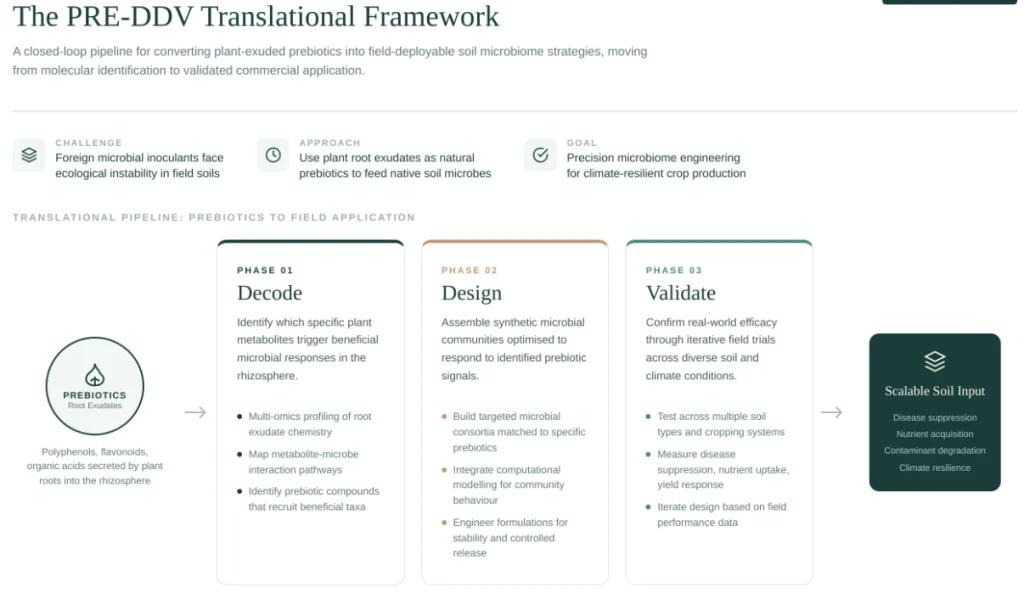
The JIPB review introduces a structured translational framework called PRE-DDV, designed to move the prebiotic concept from theory to commercial application. The framework operates through three sequential phases.
The first phase, Decode, involves using multi-omics profiling to identify precisely which plant metabolites trigger positive microbial responses. This step draws on advances in metabolomics and metagenomics that have accelerated significantly in recent years, enabling researchers to map root exudate profiles with increasing precision.
The second phase, Design, focuses on assembling synthetic microbial communities that respond optimally to specific prebiotic compounds. Rhizosphere engineering at this stage requires integrating ecological principles with computational modelling to predict how designed communities will behave under field conditions.
The third phase, Validate, involves iterative real-world field trials to confirm efficacy across soil types, climates, and cropping systems. This validation step addresses the very bottleneck that has undermined conventional biofertilizers: translating controlled results into consistent field performance.
Biofertilizer Alternatives and Commercial Scalability
Biofertilizer alternatives built on the prebiotic model face their own translational hurdles, but the JIPB review outlines several pathways to commercial viability. The authors identify scalable plant sources, including native flora and agro-industrial byproducts, as feedstock for prebiotic production. This positions the approach as potentially cost-effective, drawing on waste streams that are already abundant in major agricultural economies.
Advanced formulation technologies, including encapsulation systems, are highlighted as necessary for ensuring that prebiotic compounds remain stable in the soil and are released at the point and time when crop roots require them. Controlled-release delivery is already well established in the chemical fertilizer industry and could be adapted for biological applications.
The regulatory dimension is also significant. The review examines economic feasibility, environmental sustainability, and the policy frameworks that would govern industrial-scale prebiotic production. With the global chemical fertilizer market valued at over $229 billion in 2026, according to The Business Research Company, even marginal substitution toward prebiotic-based soil inputs represents a substantial commercial opportunity.
Sustainable Farming and the Broader Market Implications
Sustainable farming practices are increasingly central to agricultural policy worldwide. Governments in the European Union, India, and Brazil have expanded subsidies and regulatory incentives for biological and organic inputs. The prebiotic approach fits within this trajectory, offering a pathway to reduce dependence on synthetic nitrogen and phosphorus fertilizers while maintaining commercially viable yields.
The implications extend across commodity markets. Crops managed with precision microbiome tools could exhibit more stable yields under climate stress, potentially reducing the production volatility that drives price spikes in grains, oilseeds, and pulses. For agricultural commodity traders and analysts, the maturation of rhizosphere engineering from academic concept to field-deployable technology represents a structural shift in how production risk is assessed.
The research remains at an early translational stage, and the JIPB review is clear that significant field validation is still required. But the direction of travel is evident. The next generation of soil input technology may not involve adding microbes to the soil at all, but rather enabling the plant to manage its own microbial allies through precisely engineered prebiotic signals.